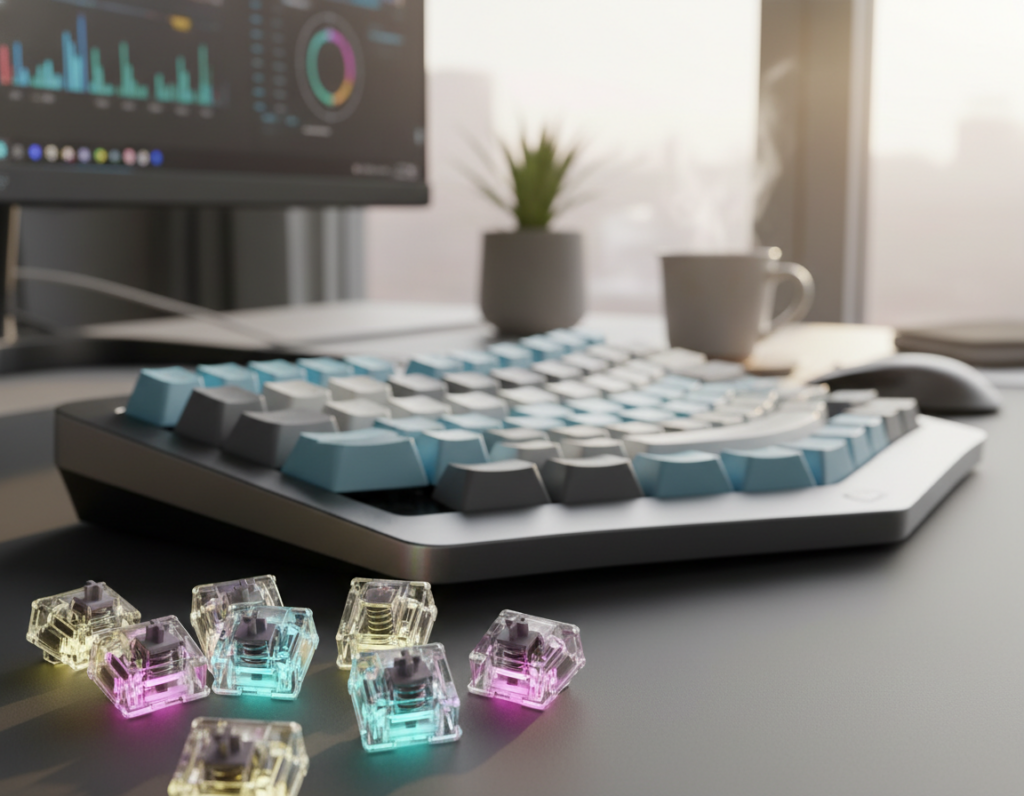
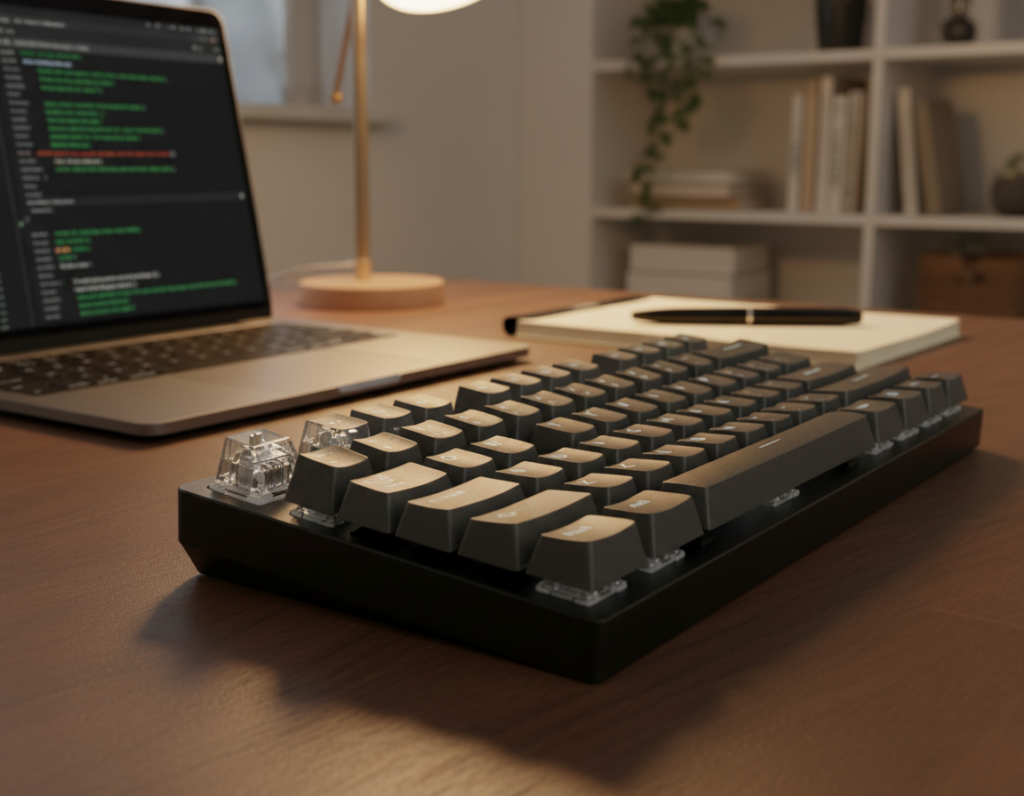
This guide helps shoppers choose frictionless linear switches for custom keyboards that deliver a smooth, consistent keystroke. We set clear goals: explain what “frictionless” can mean today and show how to compare options fairly.
Expect a compact product roundup that notes real-world limits from materials and factory lube. You will see how smoothness, sound, actuation weight, and price per pack matter when you pick parts for a full keyboard.
Linear switches often lead builders to a clean, uninterrupted downstroke compared to other types. This page previews the main decision factors and explains why many choose this path.
We cover definitions, buying criteria, top picks among 62 results, and build-matching tips. Recommendations focus on currently available, factory-lubed packs (many in 10-piece sets). Use these comparisons to choose with confidence and avoid guesswork when planning a new build or a refresh.
What “frictionless” means for a linear keyboard switch in 2026 builds
In modern builds, smoothness is measured by how little a key scratches, rings, or shifts during travel. That practical view helps shoppers compare packs and predict long-term typing behavior.
Friction points to avoid: scratch, spring ping, stem wobble, and inconsistent response
Scratch is the scratchy scrape you hear or feel when stem and housing contact unevenly. It usually comes from rough finish or poor tolerances.
Spring ping and resonance make some switches sound ringy. Cases and plates can amplify this. Even smooth parts still need build tuning.
Stem wobble reduces accuracy and adds rattle. Tighter tolerances cut wobble and give steadier hits during fast typing or gaming.
How factory lubrication changes feel, sound, and long-term typing experience
- Targets: manufacturers lube stems, sliders, and springs to cut scratch and ping.
- Good factory lube lowers pitch and smooths travel immediately.
- Over time, lube shifts and breaks in; durability and batch consistency vary.
Buying criteria for frictionless linear switches for custom keyboards
Start by narrowing priorities: actuation feel, sound goals, and per-piece price drive the best buys. A short checklist helps you compare options on a product page and avoid impulse purchases.
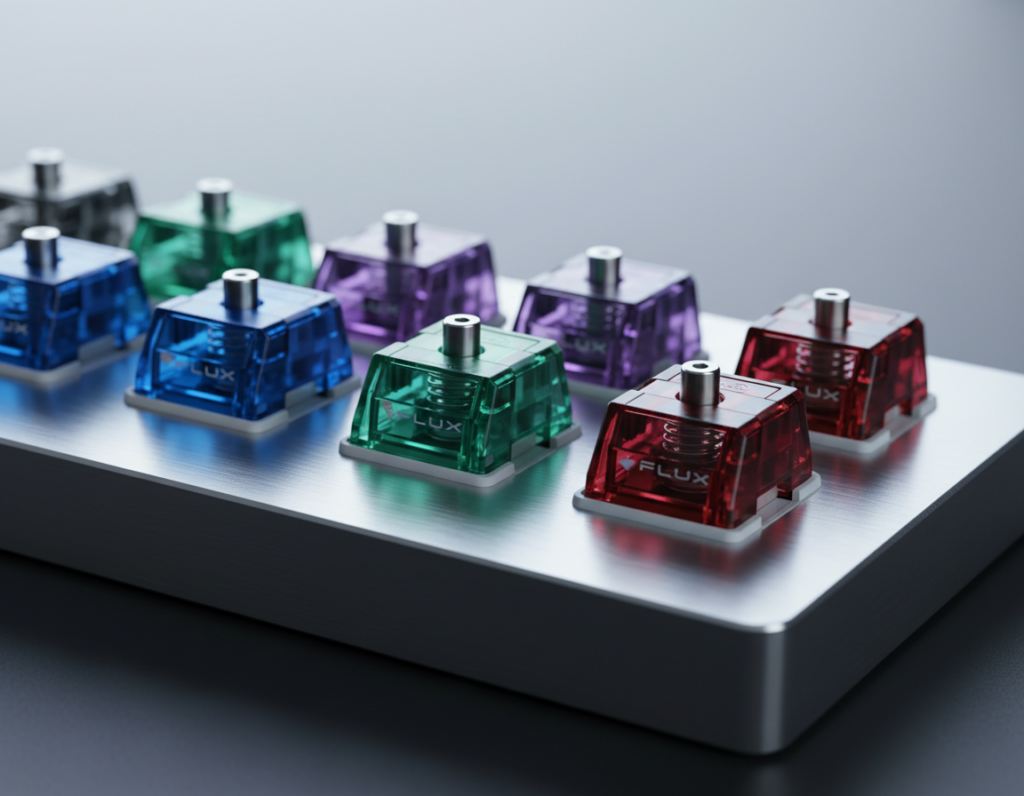
Actuation and weight: pick light vs balanced
Actuation ought to match your use. Light springs reduce fatigue during long typing sessions but risk accidental presses.
Heavier, balanced springs slow your stroke slightly and improve accuracy for fast-paced gaming and focused work.
Sound and feel: quiet smooth vs clacky clean
Decide if you want a muted, low-scratch typing experience or a brighter, more pronounced bottom-out sound.
Remember case, plate, and foam change the final sound. Don’t blame the switch alone.
Factory-lubed vs hand-lubed
Factory-lubed options give baseline smoothness and save time. Hand-lubing refines feel and sound but adds labor and skill requirements.
Common buyer questions: is lube necessary? Often yes for long-term feel. Re-lubing depends on wear and initial lube quality.
Price and pack size: test then scale
- Checklist: actuation, spring weight, material feel, sound goal, per-switch price.
- Try 10-piece trial packs (~$3.50 listed often) before committing to full sets.
- Large packs (example: $12.00 for 35pcs) lower per-unit price but may overshoot your needs.
Estimate layout size plus spares, match that to budget and performance expectations, then add to cart.
Top frictionless linear switch picks available now
Below are current, factory-lubed picks that make it simple to test feel before committing to a full set. Each entry lists pack size and regular price so you can compare value and sound quickly.
Keygeek Y3X (10pcs, $2.80)
Value entry: a low‑price 10pc pack that gives smooth travel and basic factory lube convenience for testers and budget builds.
HMX Cosmic Purple (10pcs, from $3.50)
Premium glide: cleaner downstroke and refined feel aimed at users who prioritize a silkier response and subtle sound control.
Keygeek PA (10pcs, $3.50)
Crisp consistency: tuned for steady actuation and predictable response across long sessions.
HMX Lanikai (10pcs, $3.50)
Balanced pick: blends smooth travel with an agreeable sound signature that stays unobtrusive in shared spaces.
Keygeek Y2 / Ding Ding / M3 / Roxy / Peach Cheesecake / Butterfly / Keygeek variants (10pcs, $3.50 each)
Everyday and characterful options: Y2 is a reliable all‑rounder. Ding Ding and Butterfly add personality to sound. M3 and Roxy focus on stability and refined feel. Peach Cheesecake leans softer in tone.
HMX Ash / Electric Wave / Cosmic (10pcs, $3.50)
Ash gives low‑friction travel. Electric Wave targets fast inputs with consistent response. Cosmic Purple sits at the premium glide end of this group.
HMX x 80 Retros KD400 (35pcs, $12.00)
Better per‑unit price: choose this 35pc pack when you’re ready to outfit a larger layout and cut the effective price per switch.
- Methodology: all picks are factory‑lubed with pack sizes noted for testing before scaling.
- Commerce notes (US): most orders ship within 24–48 hours; unused items returnable within 14 days with a 5% restocking fee plus shipping.
How to match switch smoothness to your keyboard build and typing goals
Match parts, not just specs. A good switch can change tone and feel dramatically once mounted. Case material, mounting style, and plate choice shape how a switch performs in real use.
Board and plate influence
Stiff plates (aluminum, brass) sharpen bottom‑out and make sound brighter. Flexible plates (polycarbonate, FR4) soften hits and can hide small scratch issues.
Mounting style matters: tray mounts ring differently than gasket or top mounts. That alters how linear switches present their travel and pitch.
Keycap profile and stabilizers
Taller profiles raise pitch and change leverage; shorter caps feel snappier. Swap a cap set to test how the typing experience shifts.
Stabilizers act like friction multipliers on larger keys. Proper lubing and wire balancing make big keys feel as smooth as the rest of the build.
Build tuning and mixed setups
Use foam, tape, or gaskets to tame unwanted resonance without reworking every part. If you mix switch types, keep primary rows consistent and only tweak modifiers to save time.
- Quiet office: flexible plate, damped case, soft caps.
- Clacky home: stiff plate, minimal damping, taller profile.
- Gaming: low weight, consistent actuation, tight mounts.
- Typing comfort: balanced weight, cushioned bottom‑out, tuned stabs.
Note: adding a tactile switch to a mostly linear set will change perceived smoothness and sound. Do this intentionally when you want contrast rather than uniform feel.
Conclusion
Start small: a 10-piece sample tells you more than specs ever will. Look for reduced scratch, minimized noise artifacts, stable travel, and a consistent response across the full set.
Validate feel and sound on your actual build, then compare total price before scaling up. Choose value (testers), premium glide, or a balanced sound and buy enough units for the layout plus spares.
Remember that plate, caps, and stabilizers change the final typing experience. Use the product page details—pack size, availability, and per-unit price—to build a cart that matches budget and goals.
US shoppers: confirm shipping times (often 24–48 hours) and return terms (unused items within 14 days; full refund minus shipping and a 5% restocking fee). If you need a quick reference on top picks, see this guide to the best linear switches.